The Combinatorial Gap
When we approach a backtracking problem, we are essentially dealing with two different magnitudes of space.
First, there is the Total Theoretical State Space. If we have $N$ decision variables, each with a cardinality (base) of $B_i$, the total number of possible configurations is the product: $\prod_{i=1}^{N} B_i$. This represents an astronomical number of potential states.
Second, there is the Effective Search Space—the set of paths that remain viable under specific constraints.
The Discovery: The Bijection
For a long time, I viewed Depth-First Search (DFS) as a structural process defined by recursion. However, upon closer inspection, I realized that DFS is fundamentally nothing more than an enumeration of states.
There exists a perfect bijection between the order in which a recursive DFS visits nodes and the sequence of numbers represented by a mixed-radix coordinate system. In other words: Walking a decision tree is mathematically identical to counting.
If we treat our state as a vector where each cell has a base $B_i$, then every single possible configuration maps uniquely to an integer in the range $[0, (\prod B_i) - 1]$. The recursive descent we see in textbooks is simply one way to implement this enumeration. But if we recognize that it is “just counting,” we can replace the volatile call stack with a stable, iterative odometer.
Example
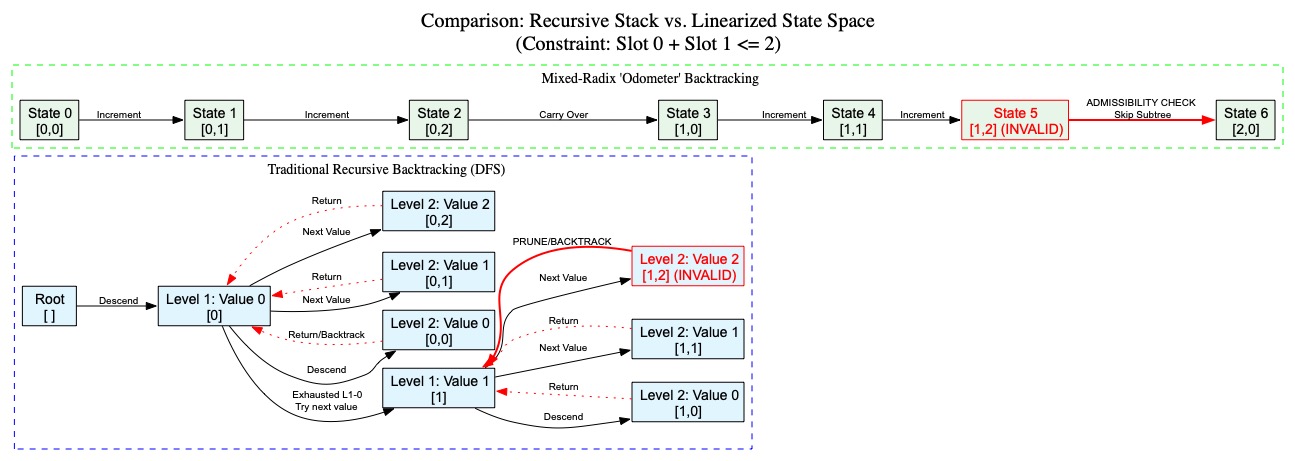 Imagine we are solving a puzzle with 3 slots, each with values
0…2.
Constraint: Slot 1 + Slot 2 cannot exceed 2.
Imagine we are solving a puzzle with 3 slots, each with values
0…2.
Constraint: Slot 1 + Slot 2 cannot exceed 2.
The Odometer: Implementing the Enumeration
By treating the state space as a mixed-radix number, we can iterate through configurations using a simple increment logic:
- Increment the most granular digit (the last index).
- When it hits its base $B_i$, reset it to zero and carry the increment to the left.
Backtracking via Admissibility
To transform this from brute-force enumeration into true backtracking, we integrate an admissibility check.
Since DFS is a lexicographical enumeration, we know that if a state at index $i$ is invalid, every single combination that follows it (all states sharing the same prefix) must also be invalid. By checking admissibility immediately after each increment, we can “jump” over vast swaths of the theoretical space—effectively purging $\prod_{j=i+1}^{N} B_j$ states in a single operation.
Implementation and Trade-offs
// Conceptual sketch of Iterative Backtracking (Odometer Style)
bool solve(std::vector<int>& state, const std::vector<int>& bases) {
    int i = 0; // Current depth/index being evaluated
    while (i >= 0 && i < state.size()) {
        state[i]++;

        // 1. Boundary Check: Reset and carry if we exceed the base
        if (state[i] >= bases[i]) {
            state[i] = 0;
            i--; // Backtrack to previous level
            continue;
        }

        // 2. Admissibility Check: The "Backtracking" step
        // If the partial solution is not admissible, we skip the entire subtree
        if (!is_admissible(state, i)) {
            // We don't increment further into this branch;
            // we stay at level 'i' and try the next value.
            continue;
        }

        // 3. Progress: If admissible, move deeper into the tree
        if (i == state.size() - 1) {
            return true; // Solution found!
        }
        i++; // Descent into next level
    }
    return false;
}
By linearizing the state space, we gain several architectural advantages:
- Stack Stability: We move from $O(\text{Depth})$ stack frames to $O(1)$ stack usage, eliminating overflow risks.
- Cache Locality: A flat vector of states is significantly more cache-friendly than fragmented recursive calls.
- Explicit Control: The search becomes a state machine that can be paused, serialized, or resumed.
While this approach is ideal for search and reliability propagation in complex graphs, I still reserve recursion for tasks like Recursive Descent Parsing. In those cases, the hierarchy of the data matches the hierarchy of the call stack, making recursion the more natural mapping.
Conclusion
The transition from recursive DFS to iterative enumeration is a shift from following a pattern to understanding the underlying mathematics. When you realize that backtracking is just a bijection between a tree and the set of integers, you stop fighting the stack and start designing for performance.