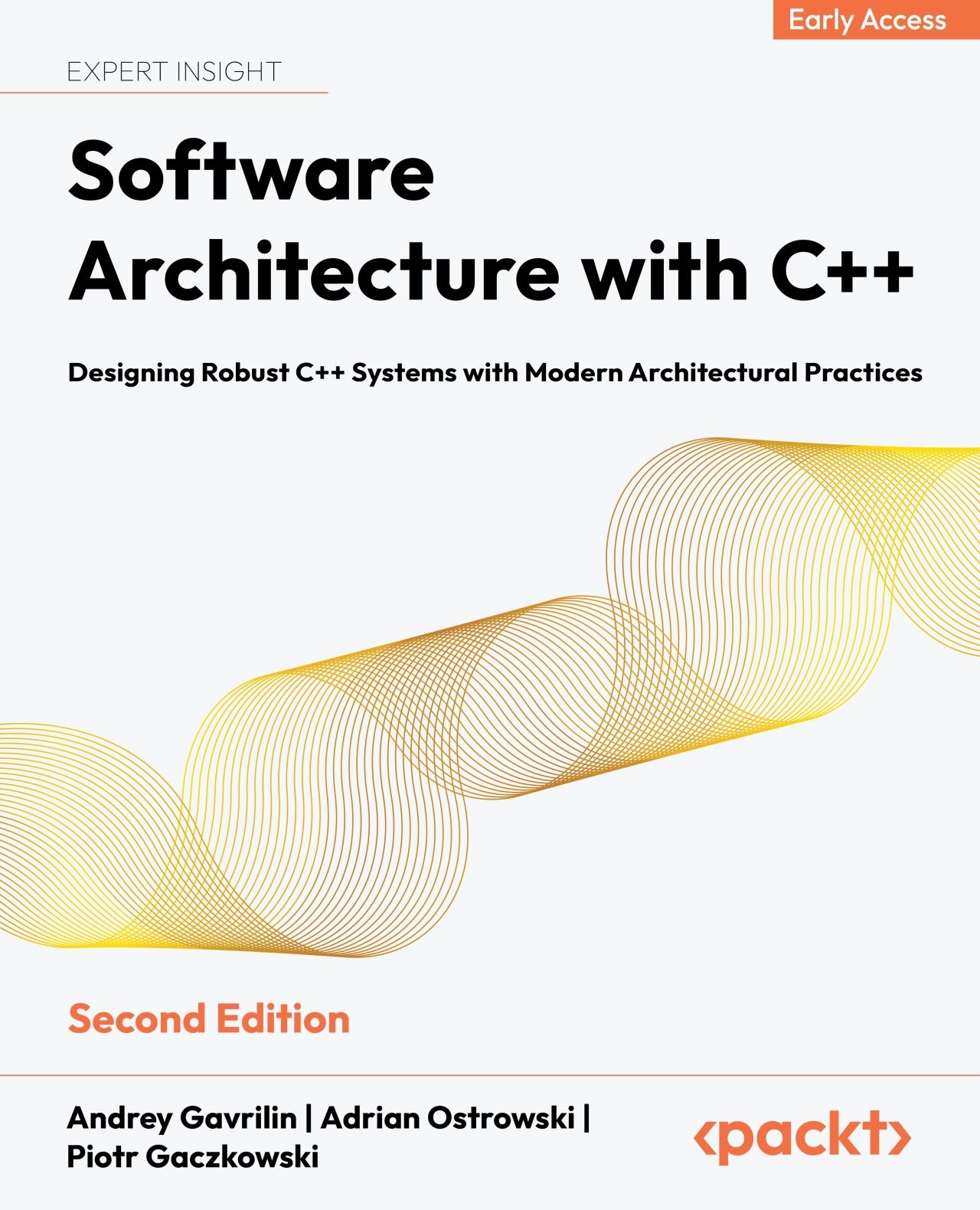
Book Review: Software Architecture with C++ — Bridging Theory and Production Reality
By Razvan Coca | Senior C++/Linux Engineer
I recently finished Software Architecture with C++ by Andrey Gavrilin, Adrian Ostrowski, and Piotr Gaczkowski. This book is not just a review; it’s an architectural compendium—a comprehensive handbook for any developer or architect serious about moving beyond “it compiles” to building truly robust, scalable enterprise systems. In an era of rapid deployment and complex distributed services, the difference between a functional prototype and production-grade software is architecture. This book successfully bridges that gap, grounding abstract concepts like SOLID principles and Microservices in pragmatic C++ code.
If you are serious about mastering system design, this is a must-read.
🧭 Table of Contents (The Roadmap)
Part I: Foundations of Great Design (The “Why”)
- Chapter 1: Importance of Architecture & Principles of Great Design (SOLID, DRY)
- Chapter 2: Architectural Styles (Monoliths vs. Microservices)
- Chapter 3: Functional & Non-Functional Requirements (The “Must-Haves”)
Part II: Building the Engine (The “How”)
- Chapter 4: Architectural & System Design Patterns (Sidecar, Adapter, CQRS)
- Chapter 5: Leveraging C++ Language Features (RAII, Smart Pointers)
- Chapter 6: Design Patterns and C++ Idioms (The Rule of Zero, Factory Methods)
Part III: The Lifecycle (The “How to Maintain”)
- Chapter 7: Building and Packaging (CMake, Conan)
- Chapter 8: Package Management & Modern C++ Modules
- Chapter 9: Testing, CI/CD, and Security (The Production Reality)
🧠 What Makes This Book Stand Out: The Critical Analysis
The authors don’t just present theory; they force you to confront the trade-offs. This is where the book earns its stripes.
🧱 Foundations: The Principles of Sound Design
The initial chapters establish the non-negotiable groundwork for any serious project:
- SOLID & DRY: These aren’t buzzwords; they are principles enforced through code. The book walks you through how to apply the Single Responsibility Principle and Dependency Inversion Principle using C++ features.
- Requirements Gathering: It dedicates a chapter to this, which is often the weakest link in any project. Understanding functional vs. non-functional requirements (latency, throughput) is the first step toward success.
- Coupling & Cohesion: It teaches you how to measure and improve these metrics, ensuring your components are truly independent and focused.
🌐 Scaling the System: The Distributed Reality
This is where the book shines, moving beyond single-machine applications into modern distributed environments:
- Service Models: It provides a balanced view of Monoliths, SOA, and Microservices—not just listing benefits, but detailing the caveats and mitigation techniques for each.
- Advanced Patterns: The deep dive into Sidecar, Ambassador, and Adapter patterns is invaluable. These are the architectural solutions needed to make modern services communicate reliably in a fault-tolerant manner.
- The Fallacies of Distributed Computing: It forces you to confront the reality that “the network is not reliable” and “latency is not zero”—a crucial mindset shift for any serious engineer.
⚙️ The C++ Implementation: Making it Real
The book doesn’t stop at the whiteboard. It grounds every concept in C++:
- Code-First Approach: The authors use real C++ snippets to illustrate abstract concepts. You learn about RAII, Smart Pointers, and Move Semantics not as theory, but as tools to build maintainable code.
- Performance & Testing: It covers everything from Microbenchmarking (using Google Benchmark) to the Testing Pyramid, teaching you how to write tests that are efficient and meaningful.
- The Build Pipeline: It walks through the modern build process—from CMake to Conan package management, and finally to CI/CD pipelines using GitLab/GitHub Actions.
💡 Final Verdict: Why This Book Matters
The most valuable takeaway is that this book teaches you how to think like an architect. It moves beyond the “how-to” and focuses on the “why.”
It is a rare resource that successfully marries the theoretical rigor of architecture with the practical, low-level power of modern C++. If you are serious about moving from a skilled developer to a true Systems Architect, this is your roadmap.